Case Study
Articulate Digital: A Constrained Studio Model
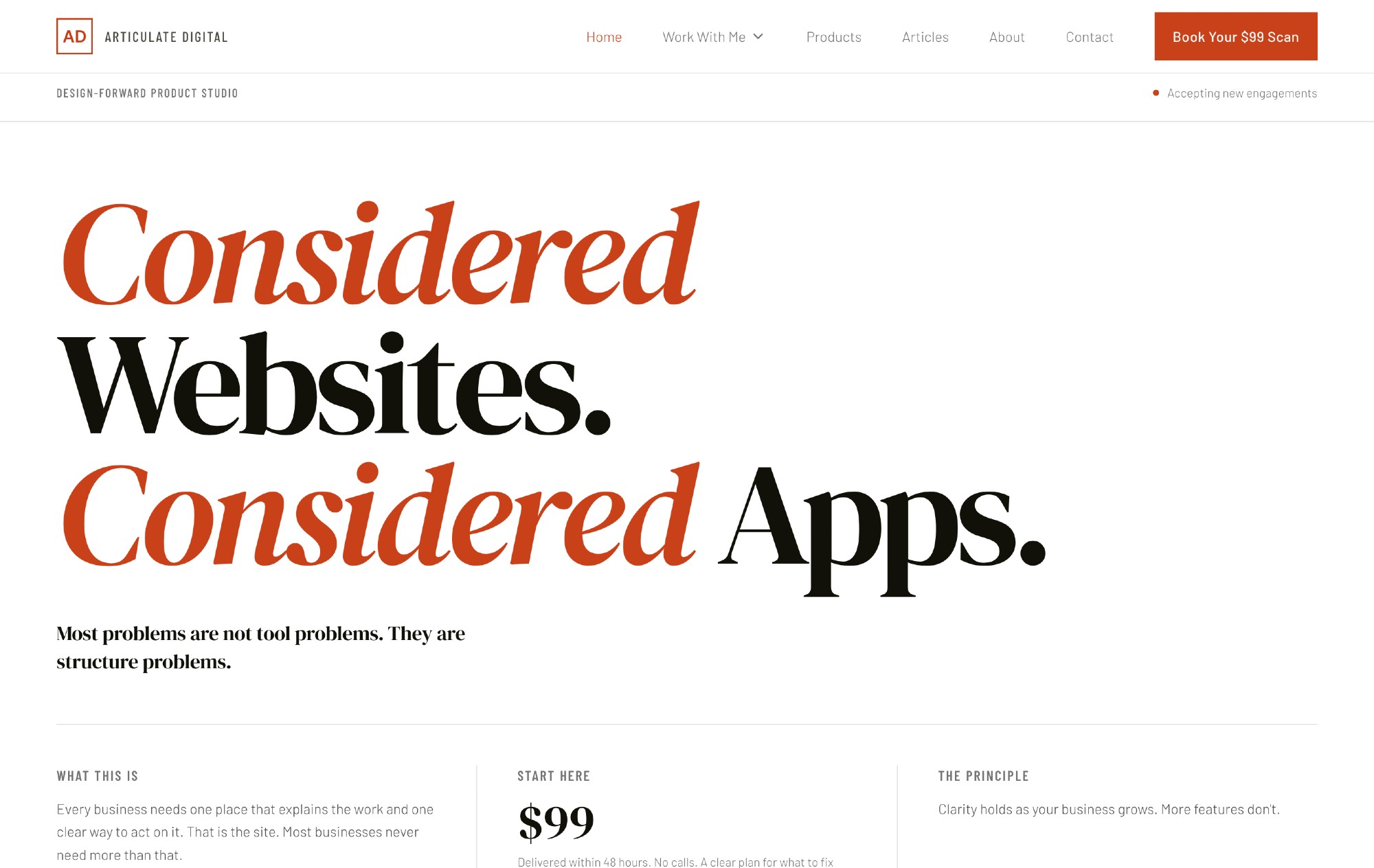
Articulate Digital was designed as a product system, not a service menu. A $99 Opportunity Scan before any build work. Scoped delivery. Documented workflows. Structure before execution.
The Product Decision
The core decision was to treat the studio as a product, not a collection of services.
Most solo service providers struggle with the same issue: polished websites layered over fragmented systems.
That means defining the problem before designing the solution, constraining scope before building, and sequencing decisions to reduce downstream ambiguity.
Instead of open-ended custom engagements, I designed a constrained offer ladder:
The structure reduces ambiguity for both client and founder. Scope is defined before execution begins.
Key Facts
- Role
- Founder + product designer
- Scope
- Studio positioning, offers, delivery
- Craft
- Constrained entry point, offer ladder
- Outcome
- Live studio, six shipped apps
- Applied product design methodology to a service business: constrained scope, defined entry points, and decisions sequenced before execution. The studio was treated as a product system, not a freelance service.
- The entry point was constrained to a $99 Opportunity Scan before any build work. Scope was controlled through a defined offer ladder. Workflow templates and documentation reduced reinvention between engagements. WordPress was chosen deliberately for client maintainability.
Architecture & Interaction
The studio model follows a structured path.
The offer ladder is an information architecture problem. Each step surfaces the right decision at the right time and removes everything else.
Interaction Model
- Navigation encodes the offer ladder.
- Conversion flow mapped before visual execution.
- Each page supports one decision at a time.
Technical Implementation
Platform Choice
WordPress was selected for client ownership and long-term maintainability. Clients retain control without dependency on a custom codebase.
Prototyping occurred before theme constraints were applied, reducing visual compromise.
Delivery Infrastructure
Repeatable delivery structures were designed before onboarding any clients. The goal was to ensure scope stayed consistent between engagements without requiring reinvention each time. Workflows were documented as reusable systems, not one-off configurations. All documentation lives in Notion with version control logic to prevent drift over time.
Tools were chosen to reduce overhead, not increase sophistication.
Versioning & Tooling
- Figma for structure and flow validation
- GitHub for version control of structured assets
- Notion as operational documentation system
Tools were chosen to reduce overhead, not increase sophistication.
Process
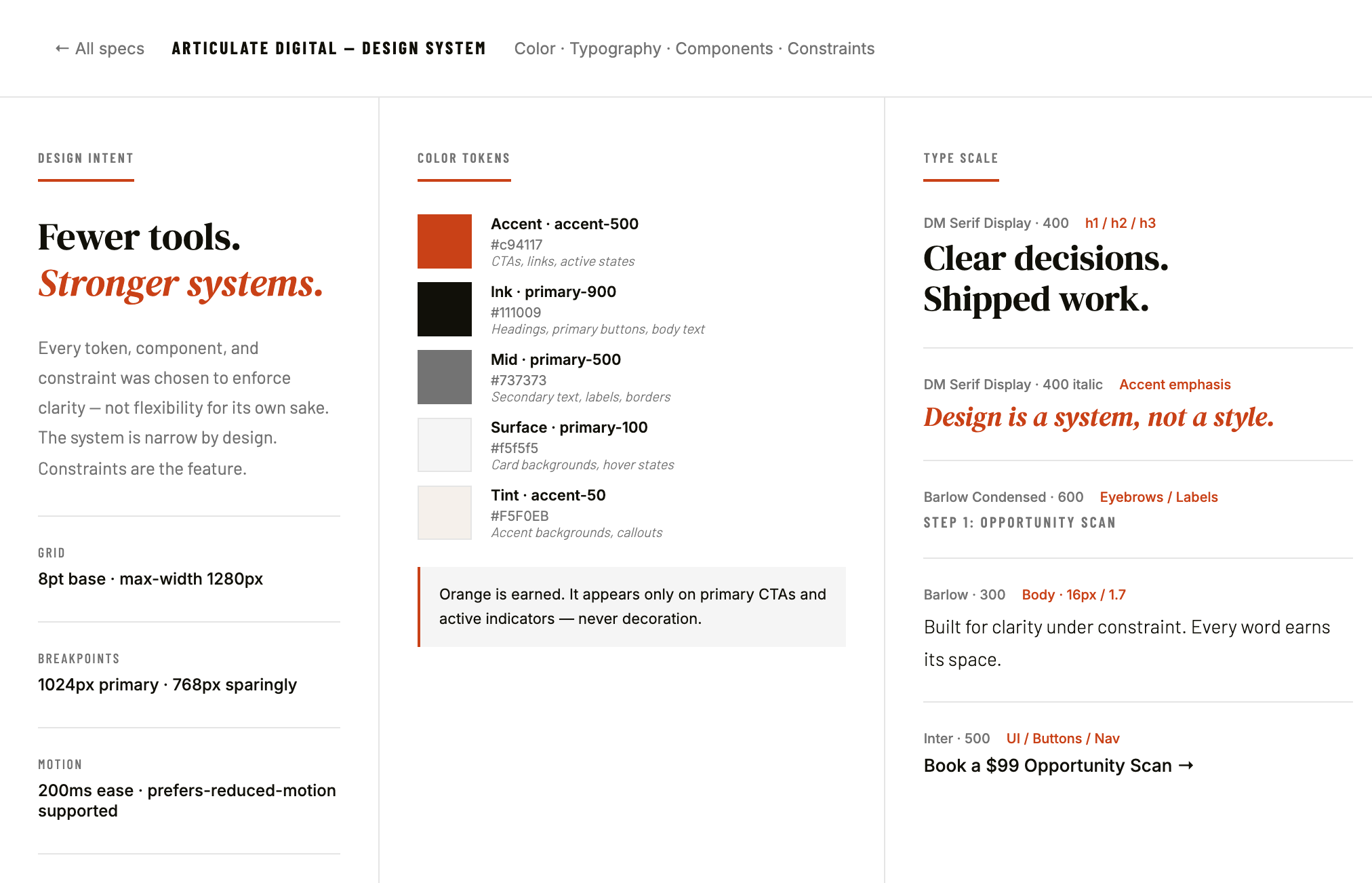
Offer constraints were defined before visual identity. The audit structure was built before the public site launched. Workflows were documented before any clients were onboarded. The entry price was validated against friction tolerance before it was published. Each of those decisions was made in sequence, deliberately, because front-loading structural clarity reduced the need to revise anything later.
Impact
I built the studio as a product, which means it can refuse work the way a product refuses a feature. In August I shelved a finished seven-file kit priced at $49 before it launched. The research I had just done turned up the same specification available free, and selling it anyway would have made the studio the thing it was built not to be. The ladder is what makes that call cheap: a $99 Opportunity Scan before any build work, the Build Decision System above it, and no price at all on App Development, because that one starts with a conversation. Scope holds because it is written into the pricing and the navigation, not defended one client at a time. The constraint discipline applied here is the same discipline applied to every system built through the studio: define the structure before adding surface.
Reflection
I underestimated how much pricing clarity reduces delivery friction. Once the offer ladder was constrained, decisions became easier for both sides.
Designing the studio as a product forced tradeoffs early. That discipline made execution faster later.