Case Study
DMV Arts Guide: Find Your Starting Point
Most arts discovery tools ask you to browse or search before you know what you want. DMV Arts Guide asks what you're trying to do. That difference defines the product.
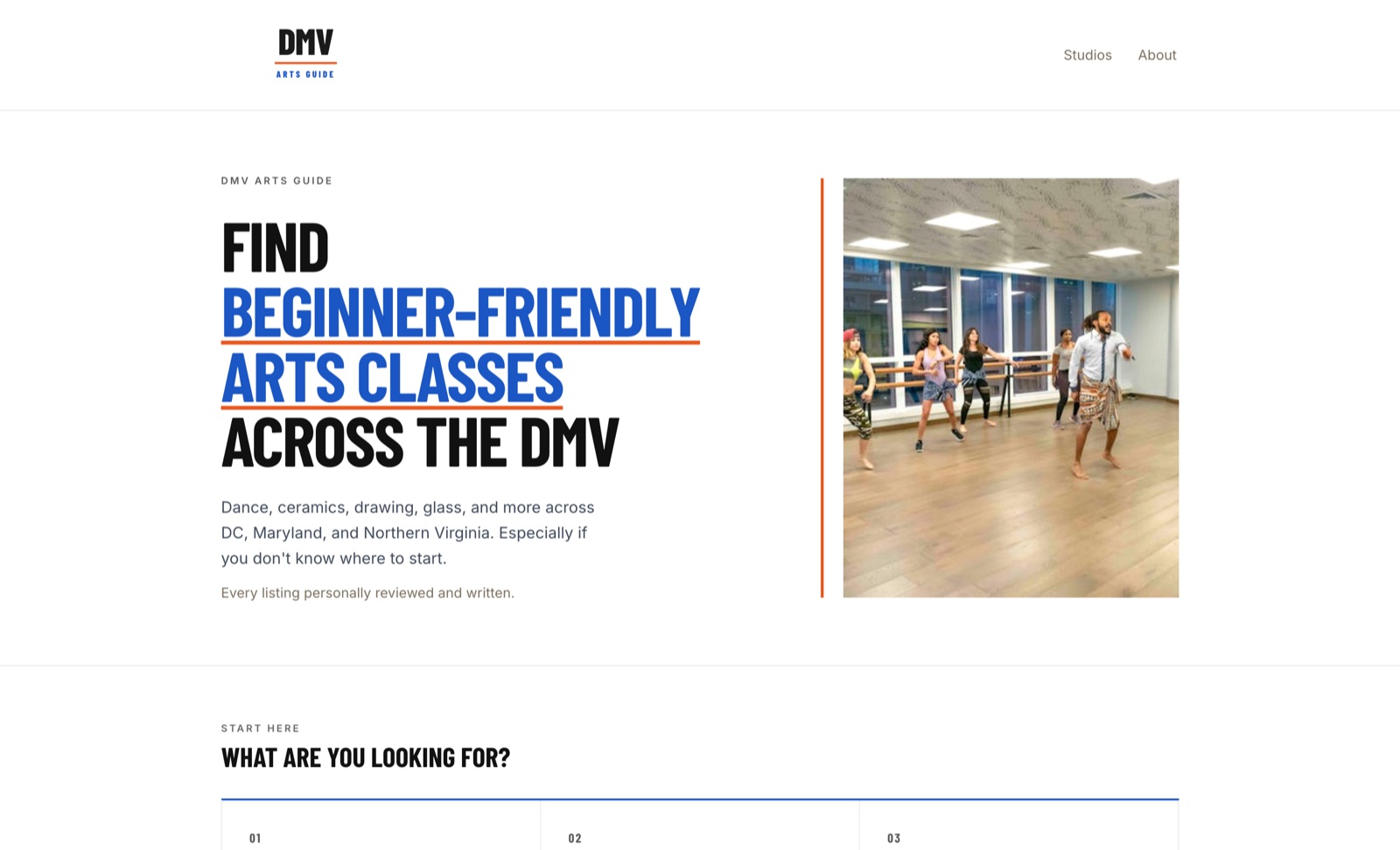
The Product Decision
The problem isn't access. It's organization for action.
Most people who want to try a dance class or pick up ceramics don't know where to start. Studios in the DMV have strong programs. The information is scattered across websites, PDFs, event listings, and Instagram pages.
The first version was a functional prototype: a searchable list with filters. It worked. It also put the burden on the user. If you didn't know what you were looking for, a search bar wasn't useful.
The redesign started with a different question. Not "where do you want to browse?" but "what are you trying to do?"
Six goal statements replaced the search bar as the primary entry point. Each one routes to a curated set of studios matched to that intent. Search still exists. It's just not the first thing you see.
Key Facts
- Role
- Designer + developer, solo
- Scope
- 0 to 1 product, design through deploy
- Stack
- Next.js, curated content system
- Craft
- Intent-based taxonomy
- The guide is built for adults of color in the DMV, and cultural competency shapes how every studio is described. Traditions are named specifically, never flattened into labels like “world dance,” and a cultural root is recorded only when the studio claims it.
- This is a curated guide, not a directory. Every listing is personally reviewed. No submissions, no pay-to-play listings, no aggregated data.
- The primary navigation is goal-based. Users don't search. They select an intent. Search exists as a tertiary action for users who already know what they want.
- The design system is built on restraint. One accent color. One typeface family. No card shadows, no rounded corners, no gradients. Every visual decision defers to the content.
Architecture
DMV Arts Guide is built around one decision: the user's goal comes before the content.
Navigation Model
Goal cards are the primary interactive element on the homepage. Search is tertiary: in the nav as a quiet text link, and once more near the bottom. "See all" links route to filtered results, not a full unstructured list. The results page heading reflects the selected goal, not a generic browse state. The map view introduces spatial discovery without requiring prior knowledge of studio names.
Design System
Editorial restraintBuilt with Next.js, TypeScript, and Tailwind. Designed for editorial restraint.
Typography
Barlow Condensed 800 for display and headings. Barlow 300–500 for body.
Color
One accent: #E8581F. It does exactly six jobs:
- Hero accent text and underline
- Section eyebrow labels
- Listing category tags
- Goal card arrow hover state
- Map pins
- Subscribe button
Cards
No border radius. No shadows. 1px #EBEBEB gap grid. All cards are white. Hover state is #F8F8F8.
Process
The first decision was structural, not visual. Browse-first navigation puts the burden on users who do not know what they are looking for. Replacing the search bar with goal cards as the primary entry point required committing to a constraint before a single component was built.
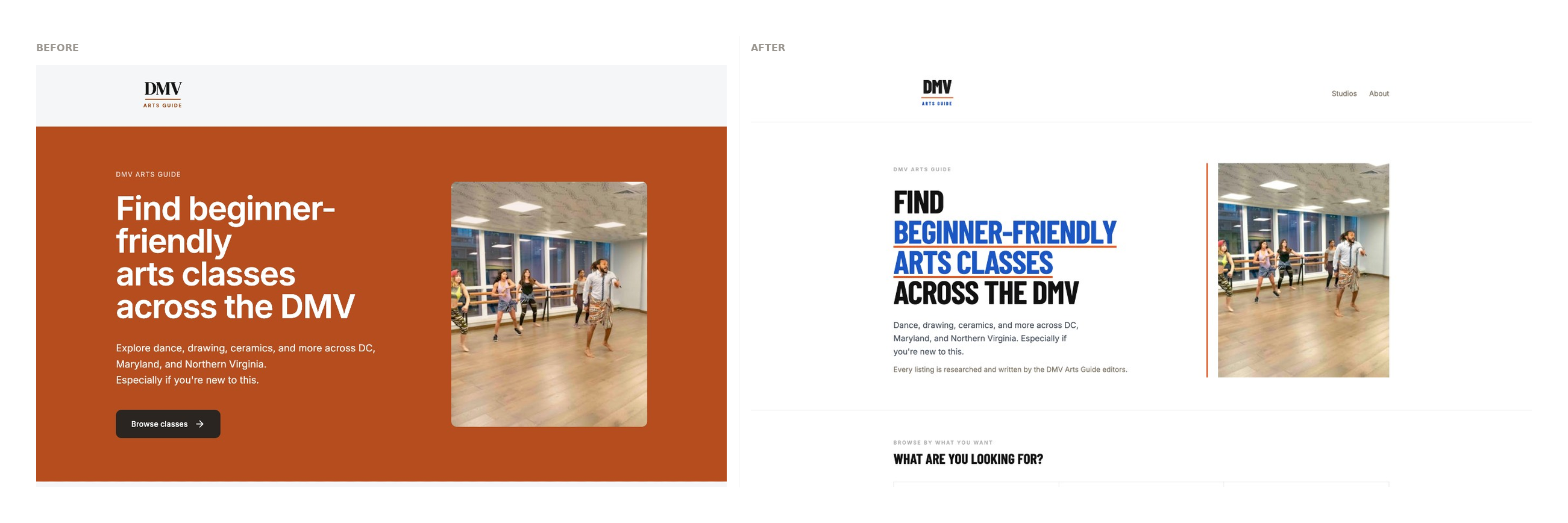
The design system was established before any components were built. Color, type, spacing, and language were audited and locked before implementation began. Every build decision in Claude Code was systematic and reversible. Nothing was added until the existing system was stable.
Impact
I spent three weeks looking for art and dance classes in DC and still could not tell you what my options were. The guide took a weekend to assemble and went live a few days after that. It lists studios across DC, Maryland, and Northern Virginia, organized by what someone is trying to do rather than by what the studios call themselves.
The editorial rule cuts copy more often than it adds it. I removed phrases like “tight class sizes” and “a reliable first stop” because they sounded helpful and I could not check them. The guide reads better when it only says what I can confirm.
It is free and I am still adding to it. What I do not know yet is whether a curated guide stays curated as it grows, because every listing I add is another one I have to keep true.
Reflection
The hardest call was removing the browse entry point from the hero.
Search is the default pattern for discovery products. It feels safe. It gives users control. Replacing it with six goal statements introduces constraint. It assumes something about the user's intent.
That tradeoff is intentional. This product is not for the user who already knows they want "West African dance in Columbia Heights." That user can use search. This product is for the user who wants to try something creative and doesn't know where to start. That user is not served by an open browse list.
The other constraint was visual. Every time the accent color expanded into a new use case, it weakened the system. Limiting where it appears made it meaningful.