Case Study · iOS
StreakFocus: Three Tasks a Day
Most task managers expand without limits, increasing mental overhead. StreakFocus limits the day to three meaningful tasks so you actually finish what you start.
The Product Decision
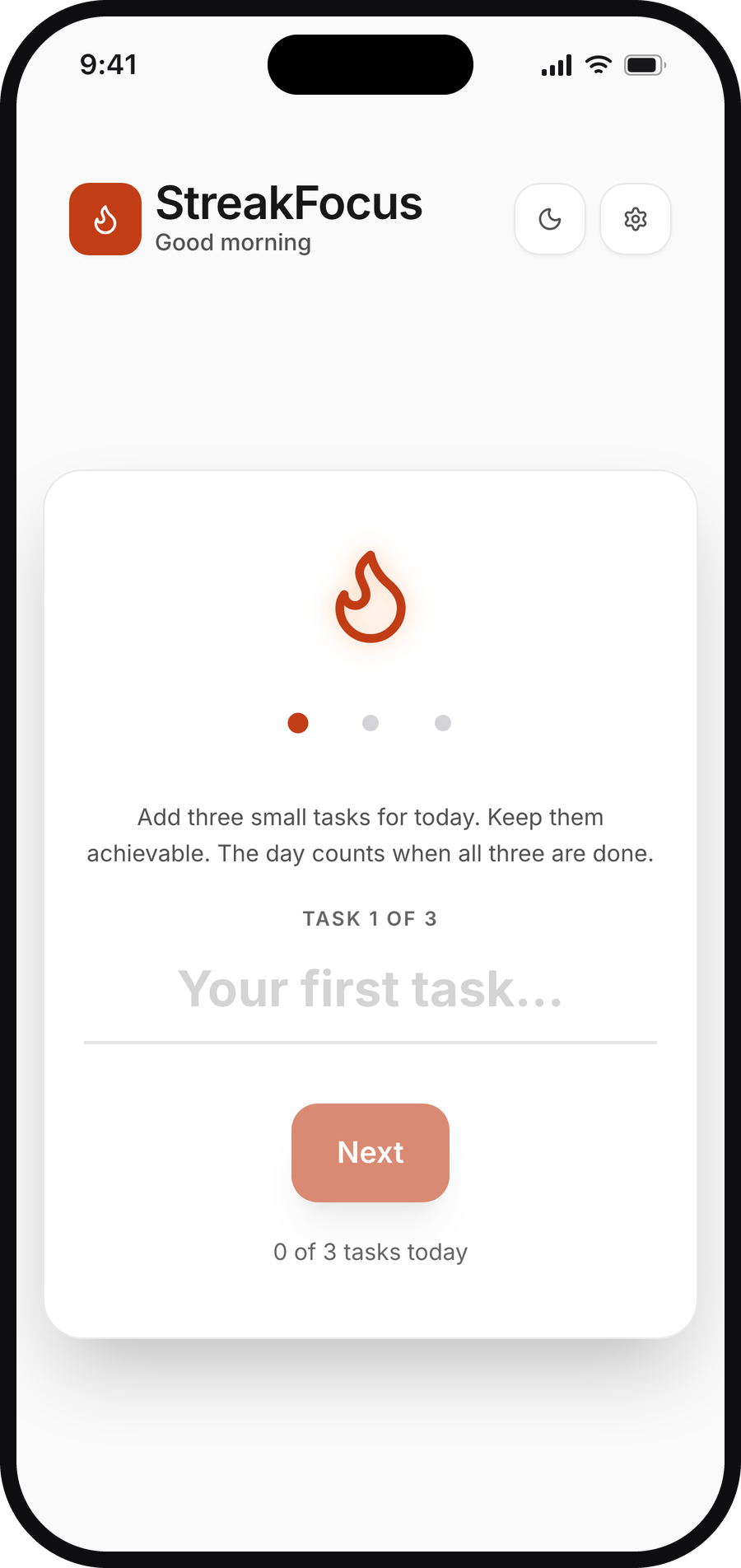
The decision was structural: impose a hard constraint. Exactly three tasks per day. Not configurable. Not expandable.
Traditional task managers scale upward. Endless lists create cognitive load. For users with ADHD, this often leads to unfinished days and broken streaks.
The constraint shapes the layout, state logic, streak validation, and celebration system. Momentum is built into the architecture, not layered on top.
Key Facts
- Role
- Designer + developer, solo
- Scope
- iOS product, 0 to 1
- Craft
- Three-task constraint model
- Outcome
- Live, App Store
- The product is built around a hard constraint: exactly three tasks per day. Not configurable. The limit is enforced in both UI and state logic.
- A 3 AM day boundary prevents accidental streak breaks around midnight and protects consistency across time edges.
- Streak validation, milestone detection, and persistence checks are structural, not decorative.
- With Reduce Motion on, card transitions are instant and celebrations keep only fades.
- All state persists locally with dayKey validation to prevent drift and corruption.
Architecture & Interaction
StreakFocus is built around one constraint: three tasks. The day has a hard ceiling.
Interaction Model
The app is structured around a single constraint: three tasks per day, no exceptions. A task is either done or not done. The day resets at 3 AM rather than midnight. That boundary exists because midnight arrives quickly and an arbitrary cutoff creates an unnecessary failure state for users, particularly those with ADHD, who are still working through their list. The later reset matches how people actually work rather than how calendars are structured.
Technical Implementation
React · TypeScript · CapacitorDesigned and built end to end using React, TypeScript, Vite, and Capacitor.
Accessibility
WCAG 2.1 AA across core flows, including:
- Visible focus indicators
- Reduced motion support
- 44px minimum touch targets (48px preferred)
- Maintained color contrast across themes
Accessibility decisions were made during system design, not retrofitted.
State Logic
Custom streak logic manages:
- Task completion validation
- Milestone detection
- 3 AM boundary resets
- Persistent storage with date integrity checks
The constraint is enforced in logic, not just visually implied.
Motion System
Four celebration styles:
- Confetti
- Rotating stars
- Fireworks bursts
- Minimal flash (reduced motion)
Each interaction reinforces progress without overwhelming attention.
Process
The constraint came first. Before any visual decisions were made, the three-task limit and the day boundary reset were defined as non-negotiable product rules. The design system was built around those constraints, not the other way around. Every component decision (the streak display, the task states, the reset behavior) was validated against the core rule before implementation began.
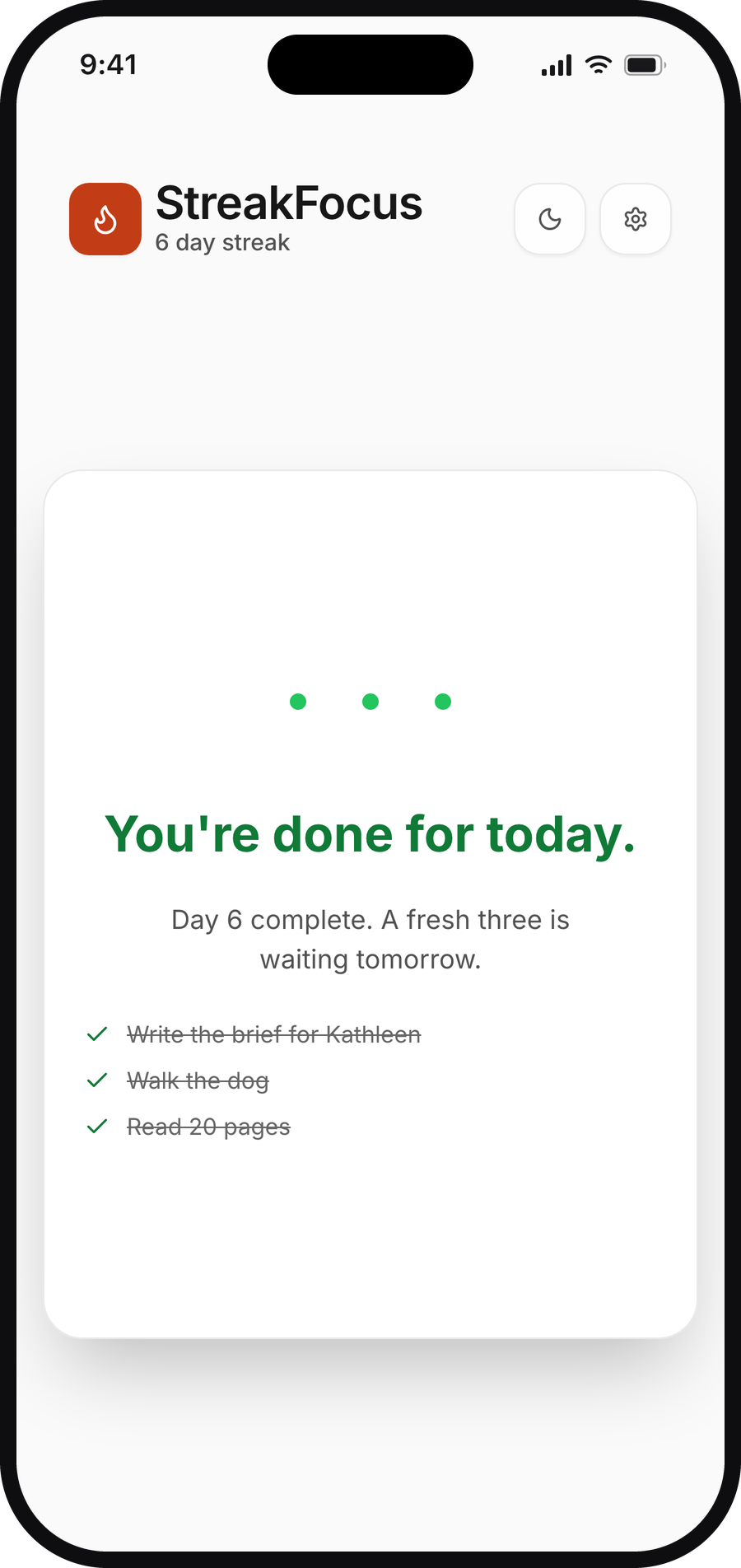
Front-loading system decisions reduced rework and kept the product cohesive.
I replaced a timer-based reminder with a state-based reminder, so the app reliably prompts you to refresh tasks even if you open it later in the day.
Impact
I built StreakFocus to test one premise: that a hard constraint on daily tasks would reduce friction rather than create it.
The premise held, and the hardest test of it was me.
Beta feedback tested that boundary. I chose to preserve the limit rather than make the product more permissive. Then twice I wanted a fourth task myself. Both times adding it would have diluted the point, and I could see exactly where it led: one more to do, then one more, then the list I built this to get out from under. The limit works because it does not negotiate, and I am the one most likely to try.
- Before submission, "wins" was renamed to "tasks" across all UI surfaces, notifications, and marketing copy. The original language implied celebration before completion.
- Streak mechanics reward showing up. Completing all three tasks counts the same whether they took twenty minutes or eight hours.
- The app shows a single task at a time. There is nothing else to choose.
- All data lives on-device. No account, no server, no sync. The streak belongs to the user.
The product shows that when constraints live in the architecture rather than in guidelines, discipline becomes a system property instead of a personal one.
Reflection
The hardest call was holding the three-task limit when testers pushed at the edges. Allowing exceptions would have made the product more flexible, but less honest about what the product was for.
Defining the constraint before designing the UI turned out to be the right sequence. It meant the state logic, milestone validation, and reset behavior all had to serve the same rule. The product stayed coherent because every system decision had to support that constraint.